

Why Intrepid's Scandinavia Explorer Through Norway, Sweden, and Finland is a great introductory tour

Some trips impress you with a single highlight. Others work because every day brings something different and interesting. My journey through Norway and Sweden on Intrepid Travel’s Scandinavia Explorer was very much the latter.
Was it the perfect trip? Not without a few modifications. I booked myself on the Oslo to Bergen railroad, and added an overnight stay so I could visit one of Norway’s most famous stave churches.
Those changes certainly added to the experience, but even without them this proved to be one of the most enjoyable tours I have taken in Scandinavia. The combination of dramatic Norwegian landscapes, charming villages, fascinating history, local culture, excellent guides, and a relaxed pace made it a journey I would happily recommend.
Quick Summary: Scandinavia Explorer at a Glance
Tour Reviewed: Intrepid Travel’s Scandinavia Explorer (Norway & Sweden)
Top Highlights: Oslo's museums, UNESCO Nærøyfjord cruise, downhill cycling along Rallarvegen into Flåm, a lakeside sauna in Dalarna, and Stockholm’s Vasa Museum.
Pro Crowd-Busting Tips: Avoid cruise-ship crowds in Bergen by walking Mount Fløyen and onto the Nordnes Peninsula; combine the Flåm railway with a bicycle return to avoid mass-tourism bottlenecks.
Essential DIY Upgrades:
Oslo–Bergen Railway: Book an independent train ticket (~$200 upgrade) to bypass the group bus detour—the mountain plateau scenery is unbeatable.
Borgund Stave Church: Add an overnight detour to visit Norway’s best-preserved 12th-century wooden church.
Add time in Oslo at the start to have sufficient time to experience the city
Overall Verdict: An ideal balance of guided logistics and independent freedom, highly recommended for travellers wanting a blend of iconic scenery and authentic local culture.
Oslo: A City Celebrating
My Scandinavian adventure began in Oslo. With a few extra days before the tour started, I had time to explore at my own pace. I wandered through some of the historic neighbourhoods, visited the city's excellent museums, cycled through the countryside, and escaped into the forests surrounding the Norwegian capital.

One of the things I love about Oslo is how quickly you can move from city streets to nature. It's the only capital city I know of where you can swim in the sea right in the heart of downtown; I biked to the Bygdoy Peninsula, home to many famous museums, through farm fields and forests; and a short ride on public transit took me into the hills above the city, where pine forests, lakes, and hiking trails provided a welcome contrast to urban life.
That evening Oslo was buzzing with excitement as Norway faced Brazil in the FIFA World Cup. The atmosphere throughout the city was electric. Supporters filled the streets, singing, chanting, and celebrating together. You haven't lived until you witness thousands of supporters doing the famous "Row!" chant in Oslo's main city square!
When Norway defeated Brazil, the city erupted. It was one of those wonderful travel moments where you find yourself caught up in a celebration that has nothing to do with being a tourist and everything to do with sharing in local life.
Should You Take the Oslo to Bergen Train, one of Europe’s Great Rail Journeys?
The following day we were told Intrepid changed the itinerary and would not take us on the famous Bergen Railway, one of Europe’s finest train journeys. Apparently the route is now so popular that overbookings are a regular occurrence and rather than exposing their groups to that, Intrepid books its clients on a long bus journey, travelling around the mountains, rather than through it.
As this was one of the main reasons for me to book this particular tour, I decided to take my chances and booked the last available ticket on the evening train. It was an unexpected $200 expense, but worth every penny.
The first part of the trip passed through green valleys dotted with traditional Norwegian farms and colourful barns. Beautiful scenery, certainly, but it was after Geilo that the landscape became truly extraordinary.

The train climbed into Norway’s mountain plateau, entering a world of rocky peaks, snowfields, sparkling lakes, and vast open spaces. Every few minutes another stunning view appeared outside the window and for several hours I was completely absorbed by the scenery. Rolling into Myrdal station, my entire compartment let out a collective "Wow!" because of the jaw-dropping landscape. It was one of those journeys where every moment outside the window is worth watching.
Late that evening I arrived in Bergen, Norway’s historic Hanseatic city where I caught up with the tour group.
How to discover Bergen Beyond Instagram
Bergen is often represented by a single image: the colourful wooden warehouses of Bryggen. They are certainly attractive, but they have been despoiled by mass-tourism, mainly due to the many cruise ships that land their thousands of passengers just a few steps away. I quickly discovered that some of Bergen’s greatest charms lie elsewhere, beyond that one Instagram image.
After rejoining the group and our excellent tour leader, Kristofer, we took the funicular to Mount Fløyen for sweeping views over the city and surrounding fjords. While most people returned by funicular, I opted to walk down through the forest.
The trail wound through peaceful woodland before descending into neighbourhoods filled with charming wooden homes. It was exactly the kind of slow exploration I enjoy.
After refuelling at a lovely local coffeeshop, I spent much of the day wandering through quieter neighbourhoods, discovering hidden corners that most visitors never see. The Nordnes Peninsula became a particular favourite. Just minutes from the tourist crowds, it felt like an entirely different city. Flower-filled streets, lovingly maintained wooden houses, locals swimming in the fjord, and peaceful waterfront views created a wonderfully relaxed atmosphere.
It reminded me that some of the best travel experiences happen when you leave the guidebook behind and simply wander.

What is the Best Way to See Nærøyfjord and Flåm?
The next stage of the journey took us into some of Norway’s most spectacular scenery.
Travelling by public coach through valleys, alongside fjords, lakes and roaring rivers, we eventually arrived in Gudvangen, where we stayed in simple but comfortable cabins surrounded by towering mountains.
That afternoon I followed the old postal road to the tiny hamlet of Bakka. It was one of those perfect walks that combines scenery, history, and tranquillity. Wildflowers lined the path, waterfalls tumbled down distant mountainsides, and the deep blue waters of the fjord reflected the surrounding peaks.

Bakka itself was idyllic. A small church, a handful of homes, and farms nestled beside the water created a scene that looked as though it had been lifted directly from a postcard.
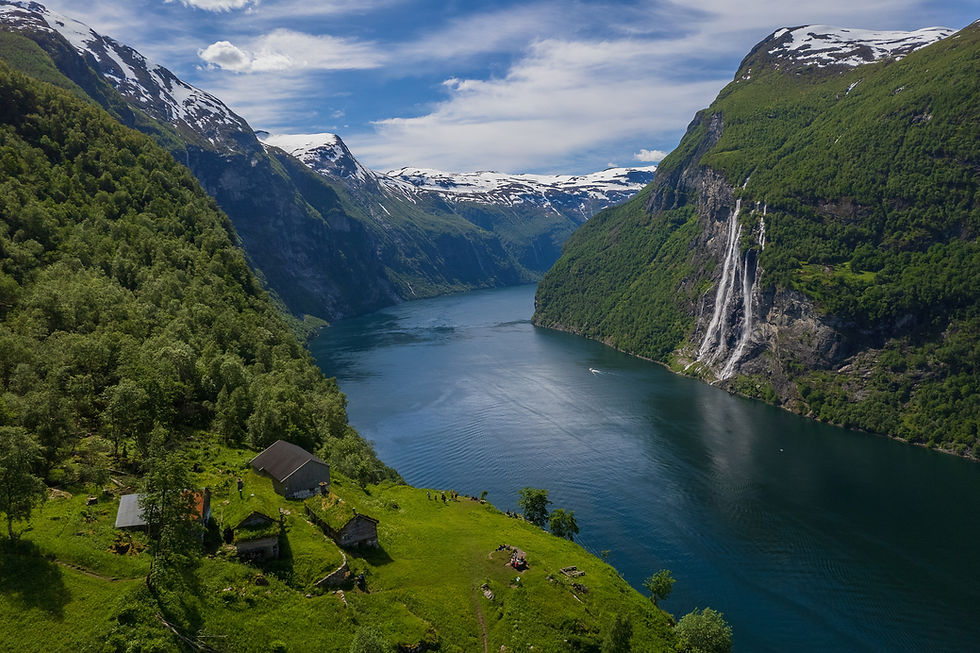
The following day brought another highlight: a cruise through the UNESCO-listed Nærøyfjord. Towering cliffs rose dramatically from the water while waterfalls cascaded down mountainsides. Even in a country filled with spectacular landscapes, the fjords remain something special.

From Flåm, I travelled up the famous Flåm Railway. Truth be told, like Bryggen in Bergen, the Flåm Railway was another disappointment. The secenery doesn't come close to that of the Oslo to Bergen railway, while the village of Flåm has been transformed into a mass-transit hub for the tens of thousands of passengers that hurriedly pass through on the Norway in a Nutshell itinerary.
What made the Flåm railway worth it was the bike ride I did in conjunction with it. I got off at the highest station, collected a bicycle and coasted back down Rallarvegen toward Flåm, enjoying one of the most scenic rides imaginable. Every turn revealed another waterfall, another mountain vista, or another beautiful stretch of valley.

That evening we were treated to a fascinating Viking storytelling session. The presenter brought Norse history to life through stories, myths, and historical insights. It added a cultural dimension that complemented the natural beauty we had been experiencing.
A Detour to Borgund - is it worth it?
The tour continued with a long busride to Lillehammer, where the group spent two nights. The day in Lillehammer saw them visit the open air museum, followed by a free day.
Rather than continue directly with the group, I left temporarily to spend a night near Borgund, home to Norway’s most famous stave church. The detour proved entirely worthwhile.
I had booked accommodation in the area and from there I walked several kilometres through the Norwegian countryside to reach the church. The route itself was lovely, passing flower-filled roadsides, farms, and quiet country lanes.
The Borgund Stave Church is one of the finest surviving examples of medieval wooden architecture anywhere in the world. Built in the 12th century, it remains remarkably intact.
Standing inside a wooden building that has survived for more than 800 years is a humbling experience. The craftsmanship, the atmosphere, and the sense of history combine to create something genuinely special.

The surrounding countryside was equally memorable. Woodland strawberries grew beside the road, wildflowers filled the meadows, and small villages provided glimpses of everyday rural life in modern Norway.
The Unexpected Magic of Dalarna
After my night in Borgund I rejoined the group in Lillehammer, from where we travelled into Sweden. If there was one place on this trip that surprised me most, it was Dalarna in central Sweden.
We stayed at a charming lakeview guesthouse in a small village surrounded by forests and water. The setting was peaceful, welcoming, and utterly relaxing.
One afternoon several of us rented the village sauna. This wasn’t a commercial wellness facility. It was the local sauna used by residents, sitting directly on the lakeshore. We spent hours alternating between the hot sauna and refreshing swims in the lake while sharing snacks, drinks, and conversation. It was one of those wonderfully simple experiences that captures the essence of Scandinavian summer.

The following day we joined a locally guided village safari led by Lotta, a local guide. This turned out to be one of the finest cultural tours I have ever experienced.
Rather than simply presenting historical facts, Lotta shared stories, traditions, folklore, and local perspectives that brought the region to life. Throughout the day we visited historic sites, villages, churches, museums, workshops, and scenic viewpoints.
What impressed me most was how connected people remain to their heritage. Many local traditions have survived for centuries. Stories are still told. Customs are still practiced. Communities continue to celebrate their history. The day included delicious local food, visits to places I never would have found independently, and countless insights into Swedish culture.

By the end of the tour I was convinced that Dalarna deserves far more attention from international travellers than it currently receives.
How to experience Stockholm's History, Culture, and Viking Heritage
Our final destination in Sweden was Stockholm. Built across numerous islands, the capital combines historic architecture, modern design, waterfront scenery, and outstanding museums.
After arriving we explored Gamla Stan, the beautifully preserved old town. Narrow cobblestone streets, colourful buildings, and hidden courtyards created endless opportunities for wandering.

Because I was to leave the tour early, our tour leader Kristofer took me on a lengthy walk through Södermalm, one of Stockholm’s most interesting districts. The views back toward the old city were magnificent, particularly in the softer evening light.
The following day was dedicated largely to museums, and Stockholm excels in this regard.
The Vasa Museum alone is worth a visit to Sweden.
The centrepiece is the Vasa, a 17th-century warship that sank on its maiden voyage in 1628 before being recovered over 300 years later. Remarkably preserved, it offers an extraordinary glimpse into life during Sweden’s imperial era.
Yet what impressed me most was not merely the ship itself but the broader story surrounding it: the politics, engineering, archaeology, and human lives connected to its history.

Later I visited the Swedish History Museum and its Viking exhibition. I had too little time to see all the detailed exhibits, fascinating artefacts, and engaging storytelling but even so, these all combined to create one of the best Viking museums I have visited anywhere.
The trip concluded for me with a memorable Viking-themed dinner. Good food, local drinks, music, storytelling, and plenty of laughter provided a fitting finale to nearly two weeks of exploration.
The group continued the trip with an overnight ferry through the thousands of islands that fill the Baltic Sea between Sweden and Finland, followed by a final free day in Helsinki. I decided to explore these islands more in depth and spend more time in Finland. But that's a story I will save for later.
Final Thoughts on Intrepid's Scandinavia Explorer
What made this trip so enjoyable wasn’t any single attraction. It was the combination of experiences.
One day I was hiking beside a Norwegian fjord, the next I was cycling through mountain valleys. Later I was sitting in a lakeside sauna in rural Sweden, exploring Viking history in Stockholm, or sharing stories with fellow travellers from around the world.

Intrepid’s Scandinavia Explorer struck an excellent balance between guided experiences and independent time. There was enough structure to make logistics easy, but plenty of freedom to pursue personal interests and discoveries.
Our tour leader was a true professional who went out of his way to make everyone feel comfortable. The accommodations ranged from comfortable city hotels to simple cabins and charming guesthouses. The transportation was efficient, the pace was manageable, and the small group atmosphere made it easy to get to know fellow travellers.
Most importantly, the journey offered a deeper look at Scandinavia than many first-time visitors experience.
Beyond the famous sights were conversations with locals, quiet villages, cultural traditions, beautiful hikes, hidden spots, lakeside saunas, medieval churches, and moments of genuine connection.

Those are the memories that remain long after the photographs have been filed away.
For travellers looking for a well-rounded introduction to Norway and Sweden—one that combines scenery, culture, history, and active experiences—I would have no hesitation recommending Scandinavia Explorer.
And if you have the chance, add a night in Borgund and take the Bergen Railway. Trust me on that.



Comments